
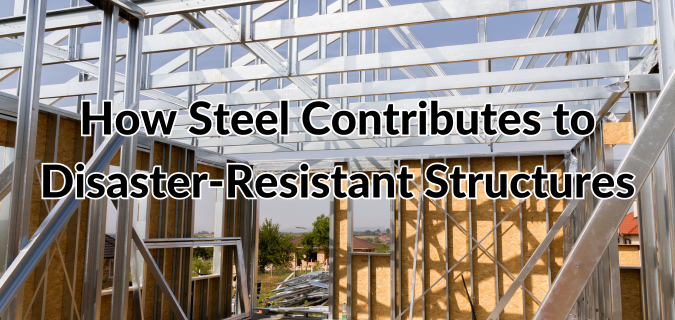
The strength, durability, flexibility, sustainability, and sheer abundance of steel make it extremely popular in the construction industry, as steel-framed buildings can be built quickly, last an exceptionally long time with minimal maintenance, and come with the lowest carbon footprint of any other building material (namely wood and concrete).
Plus, structural steel helps buildings resist natural disasters like high winds, floods, fires, and earthquakes. Among modern building materials, steel continues to prove its supremacy when facing disasters.
Learn more about steel’s many industrial applications.
The Role of Steel in Structural Integrity
What is it that makes steel so resilient, particularly against natural disasters? We can start with the tensile strength. Tensile strength measures how much pulling or stretching a material can withstand before it breaks, so the higher the tensile strength, the more force a material can endure.
The high tensile strength of steel means a steel-framed load-bearing structure can stand in extremely high winds (steel is one of the most valuable hurricane-resistant materials, though it’s important to note that for an entire building to be labelled hurricane-resistant, other factors such as design and construction methods come into play).
Maybe you’ve heard about how skyscrapers and bridges are “supposed to sway” in the wind, and that’s because steel’s high tensile strength allows it to move (usually imperceptibly to those inside) and maintain the overall structural integrity.
For more on structural integrity, take a look at how to secure your project with the proper steel bolts.
Steel vs. Natural Disasters
Let’s take a quick look at how steel stands up to individual natural disasters.
How do steel-framed structures resist the effects of an earthquake?
Again, we’re looking at the tensile strength of steel, even if it’s fighting a different force from a different origin. While the high ductility allows a steel structure to stand up to high winds, how can it lessen the impact of a massive force coming from the earth itself?
In an earthquake, the weight of a structure actually works against itself. That is, as the earth shakes the foundation of a building, the weight of that building amplifies how much force is exerted on it. Thus, a steel structure, which is much lighter than a concrete structure, for example, not only has the advantage of lower forces working against it, but its tensile strength allows the structure to flex and bend without cracking, making steel the ideal material in designing earthquake-resistant buildings.
Additional protection against earthquakes comes from steel framing techniques like moment-resisting frames, bracing, and shear walls, which absorb and dissipate seismic energy.
How does a steel structure handle fire?
Steel is fire-resistant and doesn’t ignite, although it is susceptible to losing strength at extremely high temperatures. A fire in a steel structure will spread much more slowly than in a wood structure, giving people more time to get out and firefighters more time to fight the fire. Additional fire-resistant strategies include adding coatings or using alloys with chromium, nickel, or titanium, which increase steel’s resistance to heat.
How can steel structures protect against floods?
Steel has several advantages over other building materials when it comes to flooding: steel does not absorb water, nor does water cause steel to weaken, warp, deteriorate or rot. Corrosion-resistant coatings, along with corrosion-resistant alloys, further protect steel against water damage. Often, steel structures in flood zones are built on stilts to keep the main structure above potential flood levels.
The Future of Disaster-Resistant Construction
Steel structures are not only valuable before and during disasters, with the resiliency and prevention techniques to mitigate damage, but are also valuable after disasters in that steel structures are generally quicker to repair or replace than other materials. Because of this, steel will play a major role as we move toward more prevalent disaster-resistant construction.
Prefabricated and modular steel construction cuts build times significantly. Any damage, whether minor or catastrophic, can usually be repaired much more quickly than structures made of other materials. Steel’s sustainability shows its value again here, too, as steel’s 100% recyclability drastically reduces waste and allows rebuilding and repair efforts to be done with a lower carbon footprint.
Connect with Capital Steel for Steel Supply
Where to start? Contact our steel experts today to discuss how we can help you construct more resilient buildings with steel from Capital Steel.