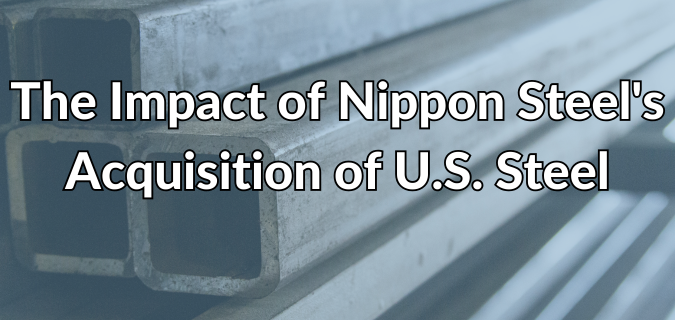
Now, nearly a year since Nippon Steel’s acquisition of U.S. Steel was finalized, we’re moving past the speculation as to what the acquisition will mean, and we’re now actually seeing the impact of the $15B deal on domestic steel supply.
The Basics of the Acquisition
The structure of the deal is intended to accomplish two things: (1) enhance Nippon Steel’s global standing and (2) strengthen U.S. Steel, an iconic American company. It took 18 months and a lot of politics and regulatory approvals from the time the acquisition was announced to the time it closed, with a few unique elements:
- Nippon Steel purchased all outstanding common shares of U.S. Steel at $55 per share. U.S. Steel is now a wholly owned subsidiary of Nippon Steel.
- Nippon Steel committed to invest in U.S. operations, promising $11B in new investments prior to 2028.
- U.S. Steel will remain headquartered in Pittsburgh, under the U.S. Steel name, with an American CEO and a majority American board of directors.
- The United States government holds a golden share, meaning certain key decisions like name changes, relocations, or plant closings can be vetoed by the government in the interest of national security.
Why Did Nippon Steel Want U.S. Steel?
From a purely business standpoint, it makes a lot of sense for Nippon Steel to acquire U.S. Steel:
- They’re instantly immersed in the North American market and are able to more directly serve clients from all industries.
- They bypass tariffs (particularly the 50% Section 232 tariff on steel), duties, and other trade barriers that have historically made it difficult for Japan to export steel to the U.S.
- They can benefit from the U.S. Infrastructure Investment and Jobs Act, which is increasing domestic demand for steel.
- They are now the world’s third-largest steel producer, which gives them more bargaining power and a more geographically diverse reach.
How the Acquisition Impacts Domestic Steel Supply
As predicted by many, it appears that domestic steel supply will continue to increase. With Nippon Steel committing to investing in U.S. production facilities and bringing in its advanced manufacturing and automation technology and processes to U.S. plants, capacity is increasing.
With more investments into more domestic facilities, upgrading their technologies and capabilities, productivity is expected to continue going up.
Plus, now as the third-largest steel producer in the world, Nippon Steel can improve the efficiency of the supply chain and increase the amount of high-grade inventory available in the United States.
Trade & Geopolitical Implications
Section 232 of the Trade Expansion Act of 1962 has been impacting the steel industry for years, particularly since 2018, when a 25% tariff was placed on imported steel (a number that increased to 50% in June of 2025, the same month the Nippon Steel acquisition closed).
However, this acquisition demonstrates the United States’ willingness to allow foreign investments and acquisitions, as long as those investors show a true commitment to domestic initiatives (such as Nippon Steel’s commitment to $11B over the next three years) and allow the U.S. government to have indirect control (that is, golden share veto power over key decisions). There is still a significant element of control for the U.S., but rather than asserting that control through section 232 tariffs, the control now lies in the golden share.
What does this mean for future foreign investments in steel and other industries? Nippon Steel has shown how it can be done, with substantial commitments to domestic interests and allowing the U.S. government a golden share. It’s worth noting that with Nippon Steel being from Japan, one of the United States’ closest allies, there is perhaps more of an opening than with companies from other countries.
Purchasing Domestic Steel from Capital Steel
The acquisition was huge for the steel industry and also for global trade as a whole, and with significant investments from Nippon Steel, domestic steel production continues to ramp up. Purchase domestic steel from Capital Steel, a small woman-owned business with five locations in the United States. Contact us today to discuss your needs and how we can help source your next project.